
 , you can listen to a streaming recording of Malaysia's jungle by clicking here.
 THE SOUND IS OVERWHELMING. From every direction comes the hallucinatory, electric simmer of insect life, a noise so pervasive that it seems to have a tangible, physical shape. After a few moments, you realize that it is also multidimensional. First, there is the big sound, the sound of the forest as one, but that is really an orchestral illusion: it is actually composed of a million "little sounds." Close your eyes, and you hear the tiny local sounds, the immediate group of chirps, squeaks, and flutters. Then, as your ears adjust, more subtle strains emerge. There are rubbings, warbles, clicks, knocks, rattles, castanets, peepings, pop-pop sounds, chirroop- sounds, sounds that go everything in the night. The more you listen, the more you become convinced that the variety of creatures singing in the night is endless.
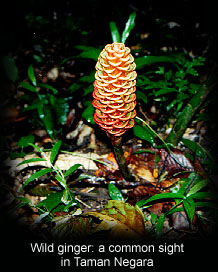 If you had to give all those sounds one name, it would be Taman Negara. Malaysians simply call it the "Green Heart," and it is Malaysia's oldest national park. It sprawls across the mountains and limestone hills of the peninsular state of Pahang, and within its boundaries is the world's oldest rain forest, a great Eden-like garden that seethes with life. It is home to more than 10,000 kinds of plants, 350 species of birds, and countless other insects and amimals - including elephant, tapir, mouse deer, and snakes. On a lucky day, you can spot a shy jaguar or a tiger. Most people who come to the park spend their days hiking the jungle trails, river-rafting, fishing or visiting the impressive canopy walkway. What many don't realize, however, is that Taman Negara truly comes alive at night.
 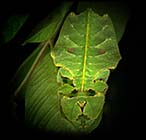 Walking through the jungle at night has often been compared to scuba diving at night. The air is dense and soupy, the sky invisible, and the world of sight is limited to the clumsy cut of your flashlight. Despite the cacophony, finding the insects and animals takes time. With 130 million years of evolution behind them, Taman Negara's bugs (as well as its plants and animals) have developed highly specialized adaptations in order to survive. Many of them have become masters of camouflage, especially the leaf and stick insects, who are far more numerous than they appear. They are virtually indistinguishable from the plant parts their names are derived from, but by patiently probing the trees with a flashlight you can usually spot them. Far easier to see are the fireflies that flare constantly across the jungle trails. Sometimes thousands of them congregate en masse upon a single tree, lighting it up like a fairy city. And fireflies are not the only life-forms in Taman Negara that produce light. The park is also well-known for its luminous mushrooms and lichens. After a rain, they glow near the trails, illuminating the night like ghostly green clouds.
  No night walk in Taman Negara is complete without a visit to one of the park's three hides. These elevated huts are situated five-minutes away from the park headquarters, and they are perfect for viewing the park's more dramatic creatures as they prowl out of the woods to enjoy salt licks. The most frequent visitor to the licks are deer and tapir, but elephants and tigers have also been know to surprise the die-hards who stay up all night (don't worry, the hides are far above the ground).
 Even if you see none of these wonders, the sound of the Green Heart beating at night is more than enough reason to bring along a good flashlight.


