
Everything you Need to Know about Kelantan
  |
History dates the origin of Kelantan from the ascension of a Thai prince Long Yunus to the throne. The state then went through Thai and British influences before becoming part of Malaysia in 1957. The name ‘Kelantan’ means ‘Land of Lightning’ evident by the many thunderstorms that rock the state each year.
While the economy of Kelantan is based on agriculture such as rice, rubber and tobacco, the state is much more famous for their Malay handicrafts which include ‘Batik’, a silky garment woven with intricate patterns, ‘kain songket’, a cloth made from gold and silver thread, mats, silverware, paintings and wood carvings.
Tourism is a growing industry as more and more people flock to see the rich Malay culture that is inherent in the lifestyles of Kelantan’s people. A trip here will surely absorb you into the knowledge of Malay culture and traditions in Malaysia.


Town & Districts
Kelantan's capital is Kota Bharu, performing all the administrative duties over the state. Kelantan is divided into 10 main districts, which are called Kota Bharu, Pasir Mas, Tumpat, Pasir Puteh, Bachok, Kuala Krai, Machang, Tanah Merah, Jeli and Gua Musang.Geography & Climate
Covering a total of 14,922 sq. km, Kelantan is rich with lush green forests. Its climate is tropical monsoon, with a stable temperature within the range of 21°C to 32°C.From January through April, expect dry and warm weather with consistently high humidity on the lowlands ranging from 82-86 percent. Kelantan's average yearly rainfall falls between 2,032 mm to 2,540 mm, with the wettest months being from November through January.
Economy
The state's economy is predominantly agrarian with paddy, rubber and tobacco as cash crops. Fishing along its coastline and livestock-rearing are also two important contributors to the economy. Other economic activities are cottage industries, like batik painting, woodcarving and songket-weaving. As mentioned earlier, tourism is fast emerging as a major money-spinner.Food
Kelantan's unique cuisine has produced delicious dishes such as Ayam Percik, Nasi Kerabu and Nasi Dagang. Ayam Percik is a favourite with locals and visitors alike. This barbecued chicken marinated with spicy coconut gravy is truly mouth-watering.Nasi Kerabu is a tasty rice-based dish, served with coconut milk, flaked fish, desiccated coconut and a variety of herbs and sauces, while everyone's favourite Nasi Dagang is actually a type of rice with a brownish tinge steamed to perfection with coconut milk and served with rich fish gravy.
Kota Bahru abounds with restaurants and food stalls, and hawkers with their tasty snacks can be found almost anywhere. Visitors looking for an outdoor Malaysian dining experience in the evening should not miss the food stalls open from 6pm to midnight at Padang Bas, in the town centre.


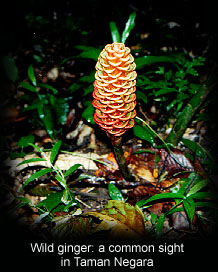 If you had to give all those sounds one name, it would be Taman Negara. Malaysians simply call it the "Green Heart," and it is Malaysia's oldest national park. It sprawls across the mountains and limestone hills of the peninsular state of Pahang, and within its boundaries is the world's oldest rain forest, a great Eden-like garden that seethes with life. It is home to more than 10,000 kinds of plants, 350 species of birds, and countless other insects and amimals - including elephant, tapir, mouse deer, and snakes. On a lucky day, you can spot a shy jaguar or a tiger. Most people who come to the park spend their days hiking the jungle trails, river-rafting, fishing or visiting the impressive canopy walkway. What many don't realize, however, is that Taman Negara truly comes alive at night.
 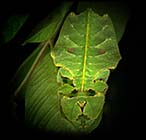 Walking through the jungle at night has often been compared to scuba diving at night. The air is dense and soupy, the sky invisible, and the world of sight is limited to the clumsy cut of your flashlight. Despite the cacophony, finding the insects and animals takes time. With 130 million years of evolution behind them, Taman Negara's bugs (as well as its plants and animals) have developed highly specialized adaptations in order to survive. Many of them have become masters of camouflage, especially the leaf and stick insects, who are far more numerous than they appear. They are virtually indistinguishable from the plant parts their names are derived from, but by patiently probing the trees with a flashlight you can usually spot them. Far easier to see are the fireflies that flare constantly across the jungle trails. Sometimes thousands of them congregate en masse upon a single tree, lighting it up like a fairy city. And fireflies are not the only life-forms in Taman Negara that produce light. The park is also well-known for its luminous mushrooms and lichens. After a rain, they glow near the trails, illuminating the night like ghostly green clouds.
  No night walk in Taman Negara is complete without a visit to one of the park's three hides. These elevated huts are situated five-minutes away from the park headquarters, and they are perfect for viewing the park's more dramatic creatures as they prowl out of the woods to enjoy salt licks. The most frequent visitor to the licks are deer and tapir, but elephants and tigers have also been know to surprise the die-hards who stay up all night (don't worry, the hides are far above the ground).


